Noémi Kreif

Health economist · Assistant Professor, The CHOICE Institute, University of Washington

I work on causal inference and machine learning methods for evaluating health policies and treatments, with a particular interest in how effects vary across people and what that implies for targeting and policy design.

Portrait of Noémi Kreif

About

Background

I am an Assistant Professor of Health Economics at the CHOICE Institute, University of Washington School of Pharmacy, which I joined in March 2024. I develop and apply causal inference and machine learning methods to estimate how the effects of health policies and treatments vary across people, and use these estimates to inform targeting, personalization and policy design. I have applied them to health insurance reforms, provider payment policies, digital health, mental health, and the health effects of conflict and violence, in high-income and low- and middle-income countries.

Before moving to Seattle I was a Senior Research Fellow at the Centre for Health Economics, University of York, and before that a Lecturer and MRC Early Career Fellow at the London School of Hygiene and Tropical Medicine, where I completed my PhD in Health Economics in 2013.

Affiliations, past and present

  • University of Washington
  • University of York
  • London School of Hygiene and Tropical Medicine
  • University of California, Berkeley
  • Kaiser Permanente Division of Research
  • Central European University
  • Corvinus University of Budapest

Recent

News

Now

Current teaching, talks and projects

Teaching

Talks

  • Nov 13, 2026Upcoming: Stanford Health Policy seminar, Stanford University“Better estimates, better decisions? Individualizing treatment with conditional average treatment effects from randomized trials”
  • Sep 2026PriMHE Programme in the Methods of Health Economics, University of Vienna (online lecture)“(Causal) machine learning for decision modeling”
  • Jun 2026SMDM Annual Meeting, Oslo: SMDM–ISPOR panel “Frontiers in causal modeling” and a contributed talk
  • 2026ASHEcon, Minneapolis, and the Health Economics Methodology Meeting, Vancouver“Choosing machine learning methods to maximize treatment classification accuracy in RCTs”
  • 2026Keynote, Rajk College Neumann Jubilee Conference, Corvinus University, Budapest

All invited talks (CV, PDF) →

Funded projects

  • 2026–2027MQ Foundation Fellowship in Economics and Mental Health Research, The Kennedy Forum. Principal investigator
  • 2026–2027A generative machine-learning model to simulate trajectories of patients with chronic lymphocytic leukemia, Clever Access S.A. (service agreement). Principal investigator

All funded projects →

Research

Research areas

Three areas, with recent examples. The Research page describes this work in more detail, in five strands, with the projects and collaborators behind it.

treatnotreatnox₁ < c₁x₂ < c₂x₃ < c₃ 01

Causal machine learning and heterogeneous treatment effects

Methods to estimate how the effects of treatments and policies vary across individuals, and policy learning to inform who should be targeted.

Recent examples

L₀A₀L₁A₁Ytime → 02

Causal inference with observational data for decision making

Doubly robust and targeted learning estimators, longitudinal treatment strategies, and the use of machine learning alongside decision models in health technology assessment.

Recent examples

policysynthetictreatedtime 03

Evaluation of health policies and social determinants of health

Quasi-experimental studies of payment reforms, quality improvement programs, digital primary care and health insurance, and of the health and economic consequences of conflict, violence and mental ill-health.

Recent examples

Featured project

Tailoring health policies

MRC New Investigator Research Grant, 2020–2023 (MR/T04487X/1). Principal investigator, with James Cussens.

This project asked how causal machine learning can show who benefits most from a health policy, and how those estimates can be used to decide who should be eligible, for example to maximize total health benefit within a fixed budget or to take account of equity. We extended causal machine learning and policy learning methods to the settings that arise in health policy evaluation: confounding in non-experimental designs, costs as well as benefits, and budget constraints.

Recent outputs

Software: fastpolicytree (R package, CRAN), developed by James Cussens on the project.

Publications

Selected publications

Full list of publications →

For event organizers

Bio and photo

Two lengths of biography, in the third person, for programs and introductions. Please use them as they are or shorten them.

Download headshot (JPG)

Short (about 70 words)

Noémi Kreif is an Assistant Professor of Health Economics at the CHOICE Institute, University of Washington School of Pharmacy. She develops and applies causal inference and machine learning methods to evaluate health policies and treatments, with a focus on how effects vary across people and what this implies for targeting and policy design. She previously held positions at the University of York and the London School of Hygiene and Tropical Medicine.

Long (about 190 words)

Noémi Kreif is an Assistant Professor of Health Economics at the CHOICE Institute, University of Washington School of Pharmacy. Her research develops causal inference and machine learning methods for evaluating health policies and treatments. She uses them to study how effects vary, for example which patients or households benefit most from a treatment or an insurance program, and how such evidence can inform targeting and policy design.

She has applied these methods to national health insurance reforms, provider payment policies, digital primary care, mental health and economic outcomes, and the health effects of conflict and violence, in high-income and low- and middle-income countries. She was a member of the ISPOR task force that produced the PALISADE checklist on machine learning in health economics and outcomes research, and she leads the UW graduate course on machine learning in health economics and outcomes research.

Before joining the University of Washington in 2024, she was a Senior Research Fellow at the Centre for Health Economics, University of York, and a Lecturer and MRC Early Career Fellow at the London School of Hygiene and Tropical Medicine, where she received her PhD in Health Economics in 2013.


Contact

Contact

I welcome inquiries from potential collaborators in health economics, epidemiology, biostatistics and clinical research.

Prospective students and postdocs (updated October 2026)

I serve on PhD dissertation and master’s committees at the CHOICE Institute, mostly on causal inference and machine learning for health policy evaluation and health technology assessment. PhD applications go through the CHOICE PhD program. If you write to me about PhD or postdoctoral work, a few sentences on the question you would like to work on and on your quantitative training help me reply usefully.

Email nkreif@uw.edu
Address The CHOICE Institute, Department of Pharmacy, School of Pharmacy, University of Washington, Seattle, WA
Profile UW School of Pharmacy faculty page

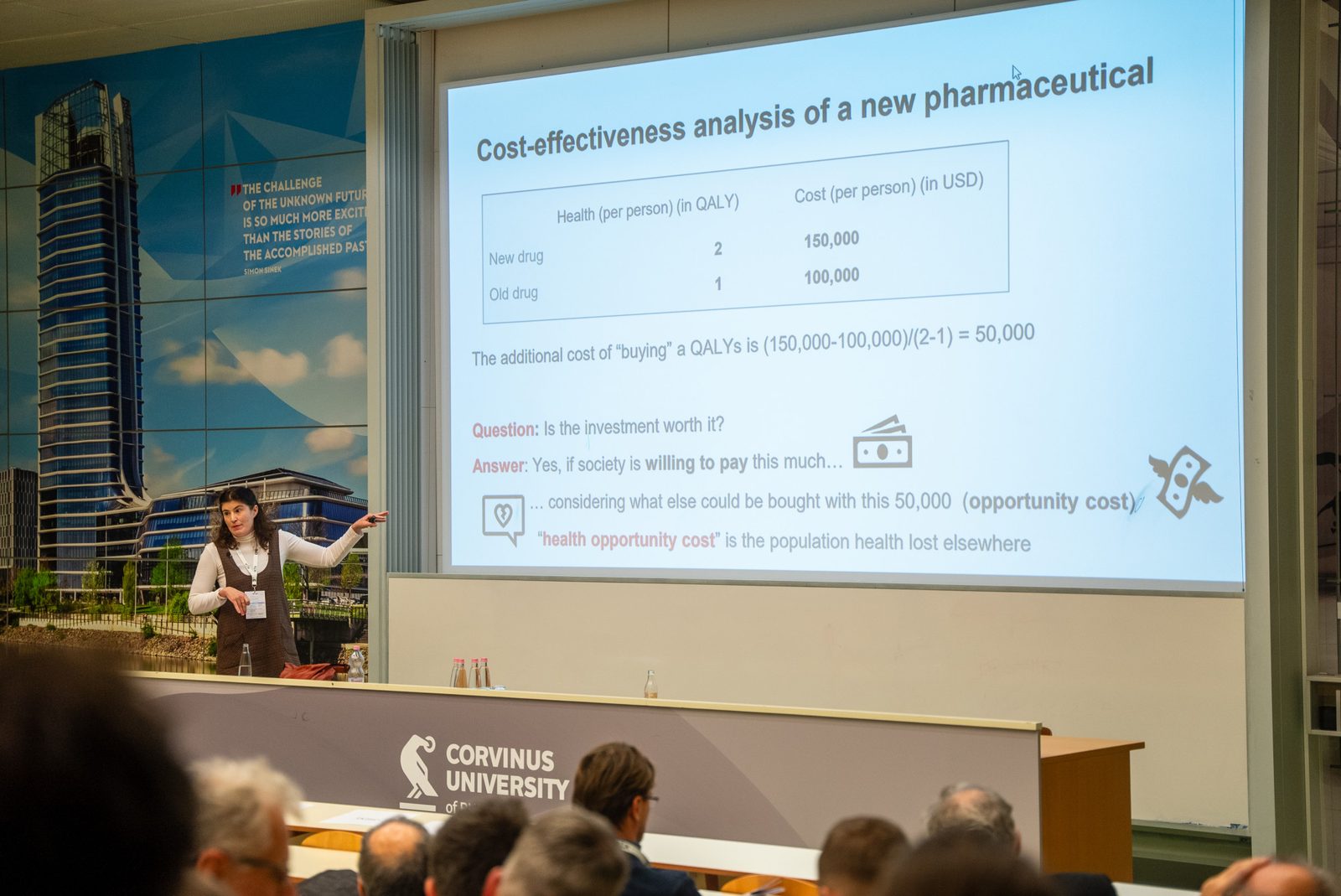
Noémi Kreif presenting a lecture on cost-effectiveness analysis at Corvinus University
Lecturing at Corvinus University of Budapest, December 2025. Photo: UW School of Pharmacy.
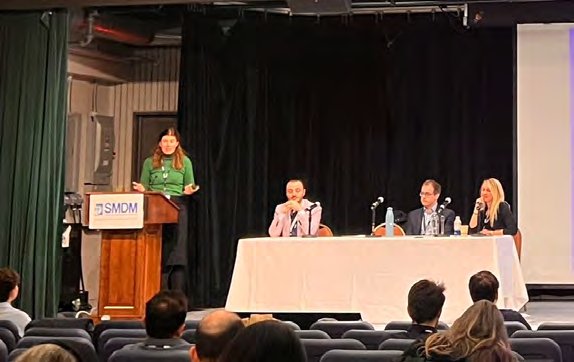
Noémi Kreif speaking at a lectern at the SMDM Annual Meeting
SMDM Annual Meeting, 2024
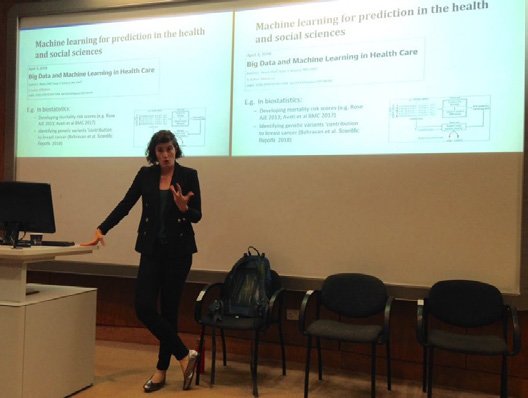
Noémi Kreif giving a seminar on machine learning for causal inference
Seminar at the Centre for Health Economics, York, 2019